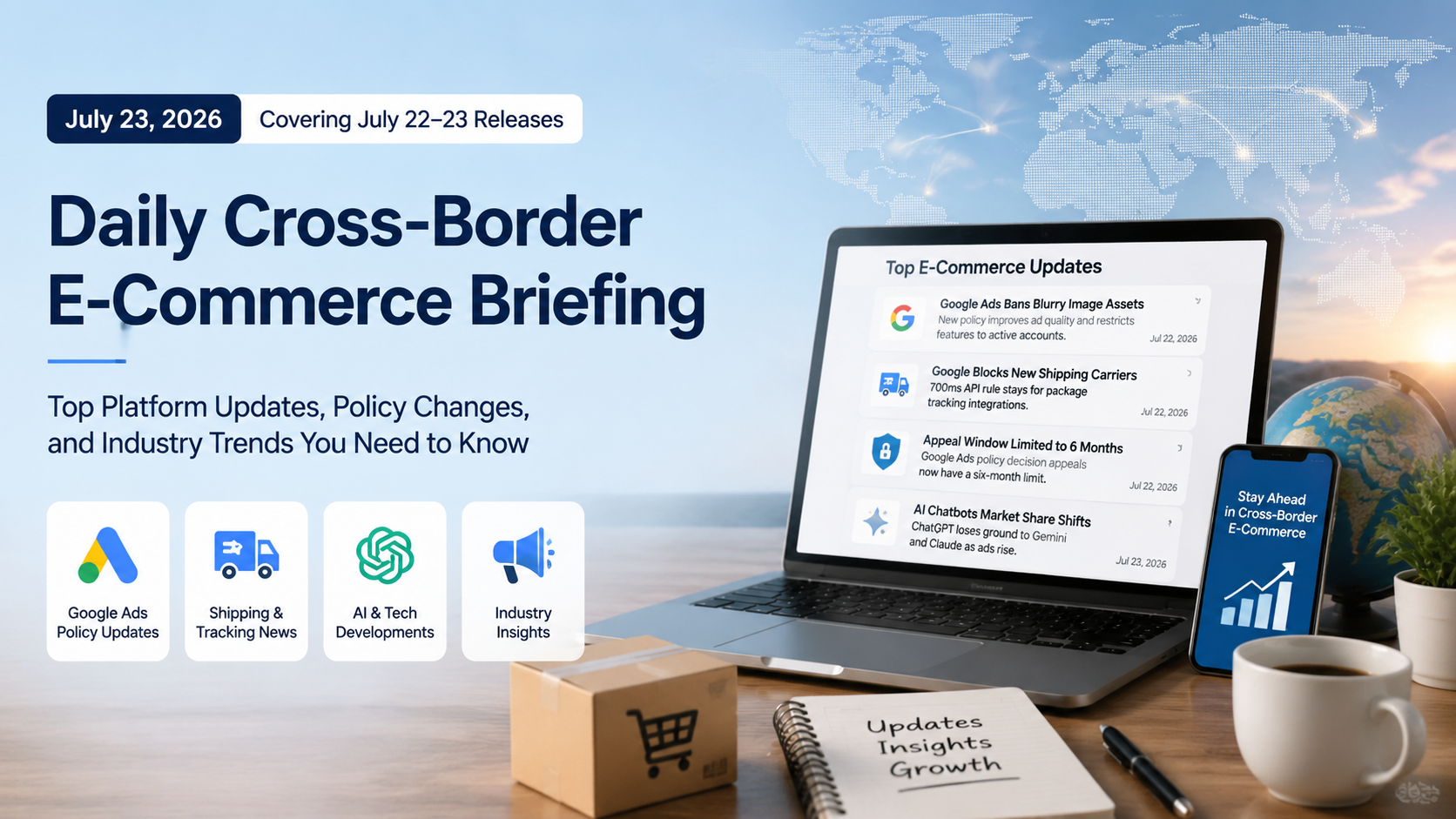
Daily Cross-Border E-Commerce Briefing | July 23, 2026 (Covering July 22–23 Releases)
1. Google Ads Bans Blurry Image Assets and Restricts Features to Active Accounts
-
Google Ads has implemented a policy ban on blurry image assets and restricted specific features to accounts active for sixty days. Announced in a developer bulletin on July 22, 2026, the updated rules automatically reject low-resolution or poor-contrast graphics. The policy aims to improve the visual quality of advertisements across the Google Display Network and YouTube placements. Google explained that new advertiser accounts must establish a sixty-day history of compliant spending before accessing advanced asset formats. The platform will automatically flag and pause ad groups containing blurry visual components starting this week.
For dropshipping stores running display or video ads to promote Shopify product listings, this visual policy requires higher design standards. Dropshippers should audit their active ad groups to ensure all product graphics are sharp, high-resolution, and free of blur. Avoid using low-quality supplier product photos that might trigger automated policy rejections and ad campaign pauses. Focus on generating clean, high-contrast promotional visuals to maintain steady delivery across Google's display placements. Ensuring your ad graphics satisfy quality standards helps independent sellers protect their advertising accounts from compliance flags.
Source: PPC Land, Published on: July 22, 2026
2. Google Blocks New Shipping Carriers from Package Tracking System Integrations
-
Google has blocked new shipping carriers from integrating with its search package tracking system, maintaining its strict response-time rules. Confirmed in a developer update on July 22, 2026, the policy restricts tracking integrations to established delivery networks. The system requires shipping partners to respond to tracking status requests within a seven hundred millisecond API timeframe. Google explained that the restriction prevents slow carrier databases from degrading the search user experience during package queries. The company advised merchants to utilize certified carrier partners to ensure tracking details render inside search results.
For dropshipping storefronts relying on automated shipping notifications to build buyer trust, this carrier restriction is highly critical. Dropshippers must verify that their suppliers ship orders using carriers that are officially certified by Google's system. Using non-certified shipping lines will prevent your package tracking numbers from displaying directly within Google Search results. Confirm with your supply chain partners that their shipping labels link to fast, compliant API tracking databases. Selecting compliant carriers ensures that your customers receive real-time shipping updates directly on their search dashboard.
Source: PPC Land, Published on: July 22, 2026
3. Google Ads Restricts Policy Decision Appeals to Six Months from Issue Date
-
Google Ads has updated its account compliance rules to restrict policy decision appeals to a six-month window. Announced in a developer update on July 22, 2026, the policy kills appeals for suspension and rejection decisions older than six months. Google explained that the limit aims to streamline support workflows and reduce backlog requests for old account audits. Marketers must submit their policy justifications and verification documents within the half-year timeframe to reactivate suspended accounts. The system will automatically lock historical policy decisions once the six-month appeal window expires.
For dropshipping merchants collaborating with diverse ad agencies or virtual staff to run campaigns, this appeal limit requires prompt action. Dropshippers should audit their historical Google Ads account notifications to identify and appeal any unresolved policy warnings immediately. Do not delay appealing ad rejections to prevent those policy violations from locking permanently on your records. Keep clean documentation of your supplier agreements and business licensing ready to submit for quick account appeals. Managing your ad compliance cases proactively protects your independent brand from permanent advertising account suspensions.
Source: PPC Land, Published on: July 22, 2026
4. ChatGPT Loses Web Market Share to Gemini and Claude as Ad Penetration Climbs
-
A research study reveals that ChatGPT has lost web market share to Gemini and Claude, even as ad penetration climbs to twenty-six percent. Published on July 22, 2026, the competitive analysis details the shifting user preferences in conversational search. The data shows that competitor platforms are capturing searchers looking for real-time web references and productivity tools. Concurrently, advertising sponsored cards are now visible in twenty-six percent of conversational chat responses globally. The study suggests that advertisers must diversify their conversational ad budgets to capture users across multiple AI platforms.
For dropshippers running digital campaigns to promote Shopify catalogs, this market shift indicates the rising importance of multi-platform marketing. Dropshippers should allocate ad budgets across both ChatGPT and Gemini networks to capture buyers on different chat tools. Monitor the conversion metrics of your conversational ads to identify which AI assistant drives the highest order values. Optimize your product landing page descriptions to align with the terms used in diverse conversational search prompts. Diversifying your conversational ad placements helps independent brands capture early sales in evolving bot-driven retail spaces.
Source: PPC Land, Published on: July 22, 2026
5. Meta Drops Webhook Polling System as Ads Endpoint Gains Real-Time Notifications
-
Meta has dropped its webhook polling system configuration, replacing it with real-time notifications for the Ads management endpoint. Released on July 22, 2026, the API update introduces eighty-eight distinct notification events for ad account changes. The updated system sends immediate push alerts when ad budgets adjust, campaigns pause, or policy rejections occur. Meta explained that removing the polling system reduces server load rates and speeds up campaign diagnostic times. The technical change is now active for all developers utilizing Meta's marketing API integrations globally.
For dropshipping stores utilizing automated ad management software to control Facebook campaigns, this Meta update improves control speed. Dropshippers should confirm that their automation software is updated to handle Meta's new real-time webhook notification events. The immediate alerts allow your campaign scripts to react instantly to ad rejections or budget spikes on your accounts. This fast response time protects your ad spend from being wasted on suboptimal ad sets during critical events. Utilizing real-time API integrations helps independent sellers scale storefront campaigns with higher precision and lower budget waste.
Source: PPC Land, Published on: July 22, 2026
6. Google Search Features Update to Run on Latest Gemini Model Version
-
Google Search has updated its conversational search features to run on the latest Gemini version model. Released on July 22, 2026, the algorithmic update deploys the three point five Flash-Lite configuration across AI Overviews search queries. The updated model version reduces response generation times by twenty percent compared to previous server setups. Google explained that the deployment improves query understanding and delivers more precise product citation links during search queries. The updated conversational search model is currently live for all global desktop and mobile search sessions.
For dropshippers utilizing search engine optimization to drive buyers to Shopify catalogs, this model update improves citation opportunities. Dropshippers should structure their product pages with clear answer logs that the updated model can easily scan and cite. Focus on adding concise product specifications that match the terms used in conversational search queries. Monitor your search traffic referral links to check if the updated model version increases clicks to your store. Aligning your product content layout with AI model formats helps independent sellers capture valuable conversational search traffic.
Source: Search Engine Roundtable, Published on: July 22, 2026
7. Google Updates Crawl Budget Documentation Advising Every Site Starts on Conservative Crawl
-
Google has updated its crawl budget optimization documentation, advising webmasters that every site starts on a conservative crawl status. Published on July 22, 2026, the developer guide explains how search bots manage server load during indexing cycles. The update details that Googlebot limits initial crawl rates for new domains to prevent server performance degradation. The search engine gradually increases crawl budgets once the domain establishes stable page load speeds and quality content. Google advised site developers to maintain clean server configurations to facilitate faster indexing rate expansions.
For dropshippers launching new Shopify or WooCommerce storefronts, this crawl budget guidance highlights the importance of site speed. Dropshippers must optimize theme code layouts and compress product graphics to maintain fast initial server response rates. A fast server response encourages Googlebot to increase your store's crawl budget and index your catalog faster. Avoid importing thousands of supplier product pages simultaneously on a new domain to prevent index page throttling. Building your storefront catalog structure cleanly ensures your products gain search visibility without indexing delay.
Source: Search Engine Roundtable, Published on: July 22, 2026